

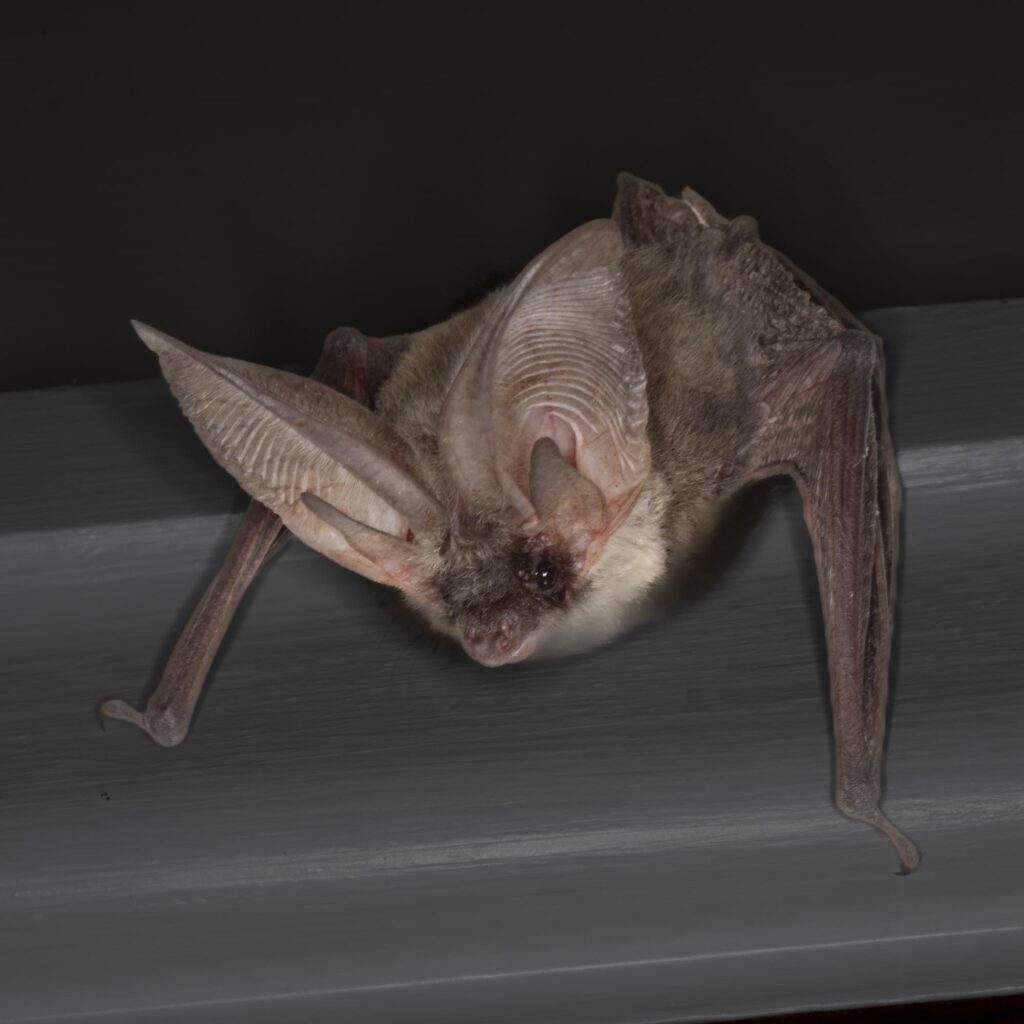

Picture the scene. It’s a warm July evening in Jersey and you’re standing in a country lane at dusk, holding a small plastic box with a dial on the front. Suddenly, click… click… click-click-click-BZZZZT. Something just caught a moth, and you heard the whole drama unfold through a bat detector.
But what actually just happened? How is a bat — flying at speed, in near-total darkness — catching tiny insects on the wing? The answer is echolocation, and it’s one of the most extraordinary sensory systems in the animal kingdom. In this post we’re going to dig into how it works, what the physics is doing, and why it matters for understanding everything your detector tells you.
The principle is beautifully simple. A bat produces an ultrasonic pulse — usually from its mouth, though horseshoe bats send calls out through their noses — and then listens for the echo that bounces back from objects in its path.
From the time delay between call and echo, the bat calculates distance. Sound travels at about 340 metres per second in air, so a delay of 2 milliseconds corresponds to a range of roughly 34 centimetres. From the Doppler shift in the echo — the same effect that makes an ambulance siren change pitch as it passes you — the bat can tell whether an object is moving towards or away from it. And from the pattern of echoes across both ears, it locates objects in three-dimensional space. All of this happens in milliseconds, hundreds of times per minute, while the bat is flying in the dark.
Bat calls are ultrasonic — above the range of human hearing. Globally, bat echolocation spans an extraordinary frequency range, from as low as 11 kHz right up to 212 kHz. Most echolocation in European species falls between about 20 kHz and 120 kHz. Human hearing tops out at roughly 20 kHz (less as we get older), which is why we need a detector to eavesdrop at all.
It’s also why echolocation remained a complete mystery for so long. Nobody could hear the bats calling. The breakthrough came in the late 1930s, when the American biologist Donald Griffin teamed up with the physicist G.W. Pierce, who had developed crystals capable of converting ultrasound into audible frequencies. For the first time, humans could listen to bat calls. The scientific community was so astonished that when Griffin and his colleague Robert Galambos presented their findings, one audience member reportedly grabbed Galambos by the lapels, convinced the whole idea was crazy.
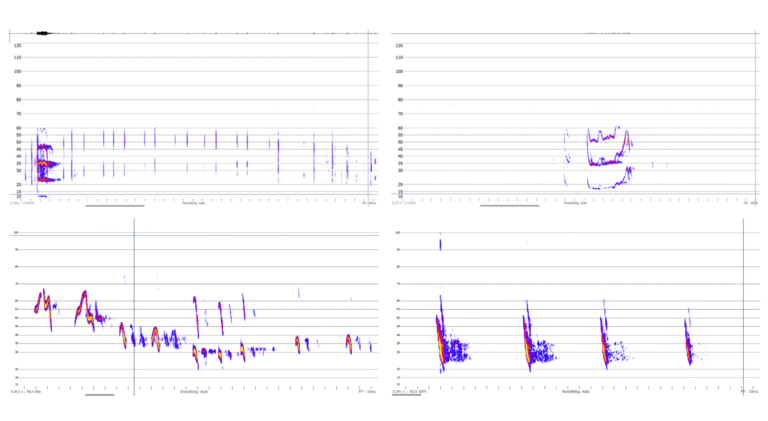
High-frequency sound has a major limitation: the atmosphere absorbs it rapidly. The higher the frequency, the faster it fades. This has profound consequences.
A call at around 45 kHz — roughly where a common pipistrelle calls — can only be detected at a maximum range of about 25–30 metres in average conditions. Push the frequency up to 110 kHz, like a lesser horseshoe bat, and the range drops to maybe 5–10 metres. Go the other direction — down to around 20 kHz, where noctules call — and the sound can carry 50 metres or more.
This creates a fundamental trade-off. High frequencies give better resolution (shorter wavelengths reflect strongly from smaller targets like insects), but they don’t travel far. Low frequencies carry further but can’t resolve fine detail. Every bat species has evolved its own compromise between these two demands, shaped by what it eats, where it hunts, and how it lives.
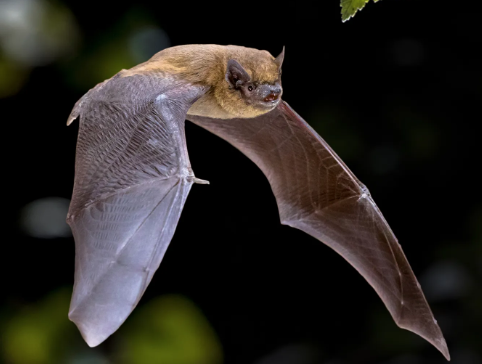
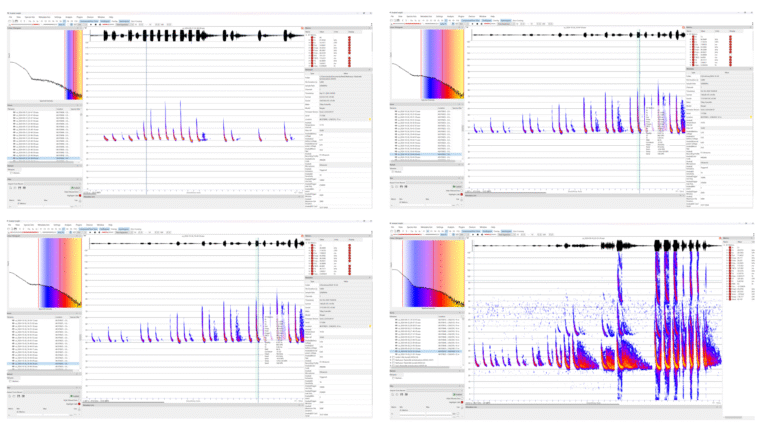
Not all bat calls are alike. In fact, echolocation calls come in three fundamentally different designs, each shaped by evolution to solve different sensory problems. Understanding these three types is the key to reading everything your detector tells you.
1. Frequency-modulated (FM) calls
Imagine a fast downward whistle, compressed into an instant. Thats an FM call, a rapid sweep through a broad range of frequencies, typically from high to low, lasting just 1-5 milliseconds. On a spectrum – a visual plot of frequency against time – FM calls can appear as steep, near-vertical swoops.
Why sweep? Because covering a wide bandwidth in a short burst gives the bat extraordinarily precise spatial information. An FM call tells the bat the distance, shape, and surface texture of nearby objects with pinpoint accuracy. Think of it as the echolocation equivalent of a high-resolution photograph. The trade-off is range because the energy is spread across many frequencies, where each frequency is relatively quiet, so the echo doesn’t carry far.
2. Constant-frequency (CF) calls
The opposite strategy. Instead of sweeping, the bat holds a single frequency for a long time, typically 20-60 milliseconds, producing a sustained, pure tone. On a spectrogram, CF calls apear as flat horizontal lines.
Concentrating all that energy at one frequency means the echo is loud and carries well. But the real genius of CF calling is what it does with the Doppler effect. Because the bat is emitting a pure tone, even the tiniest frequency shifts in the returning echo – caused, say, by the flickering wingbeats of a moth – stand out like a beacon against the steady background. Researchers call these tiny echo modulations “acoustic glints”, and they allow CF-calling bats to not just detect insect but actually classify them, distinguishing a mosquito with fast wingbeats from a beetle with slow ones, all from the echo alone.
On a heterodyn detector, CF calls sound like clear warbles or peeps. If the bat is flying towards or away from you, you’ll hear the Doppler shift as a noticeable change in pitch – the heterodyne exagerates this effect beautifully. Jersey’s horseshoe bats are the classic FM callers: the greater horseshoe around 80-83 kHs and the lesser around 110 kHz. Their calls are utterly distinctive and among the easiest to identify.
3. Composite (FM/CF) calls
Most commonly, a bat begins with an FM sweep that gradually flattens out into a CF tail — producing what bat workers often describe as a “hockey stick” shape on a spectrogram. This gives the bat broadband precision for close-range work and the longer-range detection power of a CF component. The frequency at which the call flattens out — the peak or end frequency — is one of the most useful features for identifying species acoustically.
Pipistrelles are the textbook composite callers, and they’re also the species that first demonstrated just how powerful acoustic identification can be. For many years, everyone assumed “the pipistrelle” was a single species. Then in the 1990s, bat workers noticed that some pipistrelles consistently called at around 45 kHz and others at around 55 kHz. Were these really different animals? They were. In 1999, they were formally recognised as two separate species — the common pipistrelle and the soprano pipistrelle — their split revealed entirely by their voices.
On a heterodyne detector, composite calls produce a characteristic wet “smack” or “plop” sound, quite different from the dry clicks of a pure FM caller. If you’ve ever been on a bat walk and heard that satisfying rhythmic slapping through the speaker, you were almost certainly listening to a pipistrelle.
Working to protect and conserve Jersey’s native bat species through research, education, and community involvement.
Join our mailing list to receive updates about bat walks, training, and events.
2025 Jersey Bat Group. All rights reserved.
